
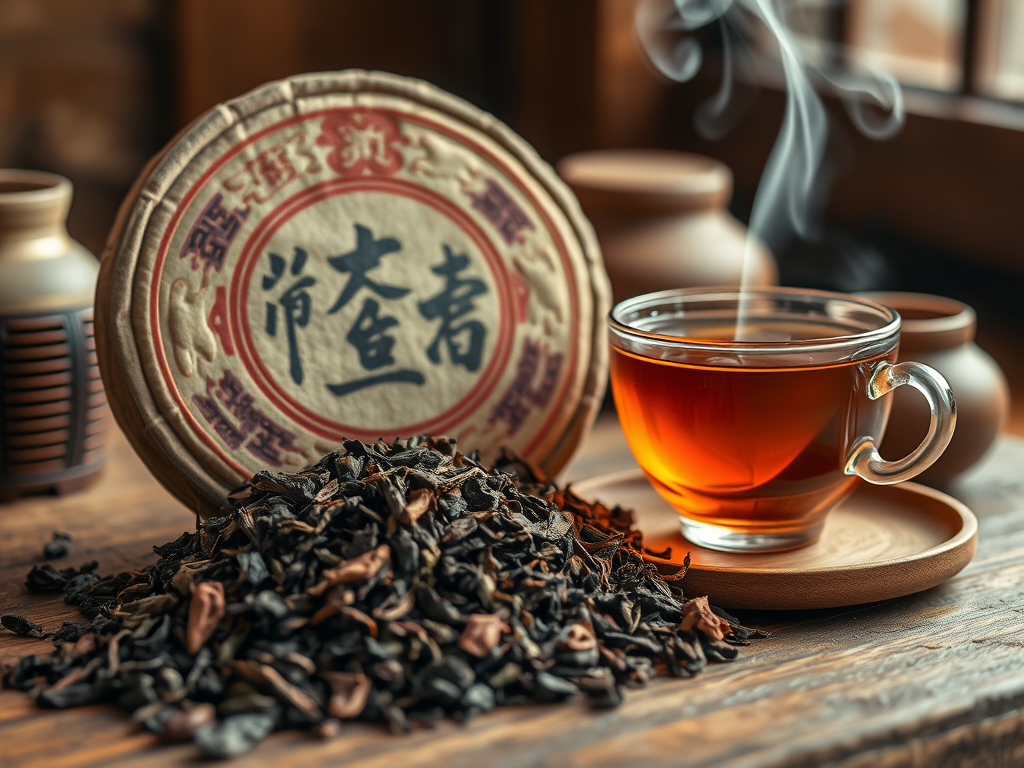
Among tea lovers and collectors, Pu-erh tea holds an almost mythical status.
Originating in the misty, ancient mountains of Yunnan, China, Pu-erh tea is a category unto itself. It’s fermented, aged, pressed into cakes, and in some cases, it can fetch thousands of dollars depending on its origin and age. But what makes this tea so prized? How is it produced, and why are certain mountain regions considered sacred among tea aficionados?
Let’s explore the fascinating world of Pu-erh tea—from imperial courts of old to the thriving global market of today.

What Is Pu-erh Tea?
Pu-erh (pronounced poo-air) is a unique type of fermented tea that hails exclusively from Yunnan Province in southwestern China. Unlike green or black tea, Pu-erh undergoes microbial fermentation and oxidation—a process that can take months, years, or even decades.
There are two main types:
- Sheng (Raw) Pu-erh: This traditional form of Pu-erh is naturally fermented over many years. It starts off bold and astringent but mellows with time into something profound, earthy, and sweet.
- Shou (Ripe) Pu-erh: Developed in the 1970s to simulate the aging of Sheng, this variety undergoes accelerated fermentation. The result is a rich, dark brew with notes of earth, leather, and occasionally dark chocolate.
Both types are commonly compressed into various shapes—round cakes (bing cha), bricks, or small domes (tuo cha)—making them ideal for aging and long-distance transport.
How Pu-erh Tea Is Made
While Pu-erh tea retains many traditional elements, modern production strikes a balance between heritage and controlled methods and quality standards. The process varies slightly between Sheng and Shou Pu-erh, but both follow a structured flow:
1. Harvesting
Tea leaves are typically harvested in early spring when the buds and top leaves are most tender. Handpicking is still the norm in many regions, particularly where ancient tea trees are found.
2. Withering (Shai Qing)
Freshly picked leaves are spread out in the sun to wither. This step reduces moisture and makes the leaves pliable for further processing.
3. Fixing (Sha Qing)
The leaves are briefly heated in large pans to halt enzymatic oxidation. This “kill-green” step preserves the tea’s aromatic compounds and green appearance, essential in Sheng Pu-erh.
4. Rolling (Rounian)
The softened leaves are hand-rolled or machine-rolled to break the cell walls. This enhances flavor development and prepares the tea for drying.
5. Sun-Drying (Shai Gan)
After rolling, the leaves are laid out under the sun to dry. This natural drying process is crucial—it encourages microbial activity that starts fermentation.
At this stage, the loose-leaf Sheng Pu-erh (Mao Cha) is ready for consumption or pressing.
6. Fermentation (for Shou Pu-erh only)
To produce Shou Pu-erh, the dried leaves undergo wo dui—a “wet piling” method introduced in the 1970s. The tea is heaped into piles, moistened, and turned regularly over 45–60 days. This accelerates microbial fermentation, transforming the tea’s color and flavor.
7. Sorting and Grading
Tea leaves are sorted by size and quality. Leaf grades can affect not only flavor but also price.
8. Compression
The tea is steamed to make it pliable and then compressed into cakes, bricks, or domes using stone molds or hydraulic presses. Compressed tea is easier to store, ship, and age.
9. Aging and Storage
Pu-erh continues to age post-production. Proper storage is essential—away from light, odors, and excessive moisture—to promote healthy microbial activity and flavor development over time.
This meticulous process is part of what makes Pu-erh so treasured. Each stage contributes to its evolving complexity, allowing even the same tea to taste different year by year.

A Tea Steeped in History
From the Tang Dynasty to the Tea Horse Road
Pu-erh tea has been cultivated for over a thousand years, dating back to the Tang Dynasty (618–907 CE). Because Yunnan is mountainous and rugged, early tea traders began pressing tea into bricks and cakes for ease of storage and travel.
During the Song and Ming dynasties, these bricks weren’t just for brewing—they were used as currency. Traders traveled the famed Ancient Tea Horse Road (Cha Ma Dao), carrying loads of Pu-erh to Tibet, India, and beyond in exchange for salt, horses, and furs. The tea became known not just for its flavor, but for its value and diplomatic significance.
Eventually, Pu-erh earned the status of “tribute tea,” a designation reserved for brews served in the royal courts.
Modern Revolution
The 20th century brought rapid change. In the 1970s, the Chinese government introduced the Shou fermentation method to speed up the aging process, making Pu-erh more widely available. Large state-owned factories like Menghai and Kunming began to standardize and brand their products, some of which are still sought after by collectors today.
In the modern era, vintage Pu-erh cakes have become investment items. Aged teas from the 1980s or earlier can now sell for thousands of dollars, particularly in Hong Kong, Taiwan, and increasingly, in Western tea circles.
Where the Magic Happens: The Terroir of Pu-erh
The quality, character, and even the price of Pu-erh tea are intimately tied to the land it grows on. Yunnan’s mountainous topography, ancient tea forests, and microclimates all contribute to the diversity of Pu-erh profiles. The region’s terroir—the combination of soil, climate, altitude, and biodiversity—plays a vital role in shaping each tea’s unique personality.
Here are the four most celebrated Pu-erh-producing areas in Yunnan:
1. Xishuangbanna Prefecture
- Key Areas: Menghai, Yiwu, Bulang, Jingmai, Nannuo
- Flavor Profile: Earthy, floral, rich and complex
Xishuangbanna is often considered the heart of Pu-erh tea culture. It’s home to ancient tea trees, some over 800 years old, and is one of the most biodiverse tea regions in the world. Teas from Yiwu are known for their smooth, sweet, and elegant profiles, while Bulang teas offer strong bitterness that mellows beautifully with age. Menghai is famous for its bold, earthy flavors that are perfect for long-term aging.
2. Pu’er City (Formerly Simao)
- Key Areas: Mojiang, Jingdong, Ning’er
- Flavor Profile: Balanced, mellow, and approachable
This central region gave Pu-erh its name. A major trade and processing hub historically, Pu’er City continues to be a vital center for tea production today. Teas from this area are well-suited to new drinkers due to their smooth, accessible taste. The slightly cooler climate compared to southern Yunnan also impacts how teas mature.
3. Lincang Region
- Key Areas: Bingdao, Yongde, Mengku
- Flavor Profile: Bitter-sweet, mineral-rich, and energetic
Lincang is famous for its bold and expressive raw Pu-erh teas. Bingdao, in particular, is a prized village known for producing teas with a cooling sensation and high minerality. These teas often start off bitter but transform into sweetness with age. The region’s old-growth tea trees also contribute to the tea’s complexity and strength.
4. Baoshan Region
- Key Areas: Tengchong, Longyang
- Flavor Profile: Light, clean, and subtly sweet
Baoshan is gaining recognition for producing Pu-erh teas that are soft, smooth, and ideal for those who prefer a more delicate brew. The volcanic soil and unique altitude conditions create teas with clarity and nuance. Though not as well-known internationally, Baoshan’s reputation is on the rise among discerning collectors.
| Region | Notable Flavor Profile | Key Areas |
|---|---|---|
| Xishuangbanna | Earthy, floral, rich | Menghai, Yiwu, Bulang |
| Pu’er City | Mellow, smooth, balanced | Mojiang, Ning’er, Jingdong |
| Lincang | Bitter-sweet, mineral-rich | Bingdao, Yongde, Mengku |
| Baoshan | Clean, soft, subtly sweet | Tengchong, Longyang |
Related Post: